History · Archaeology
History and excavations of the Cave of Poetry
Who discovered it, what is written on the walls of the Poesia Piccola, and how forty years of excavations rewrote the history of Roca.
Updated 10 November 2026 · ApuliaOutdoor
Before the discovery
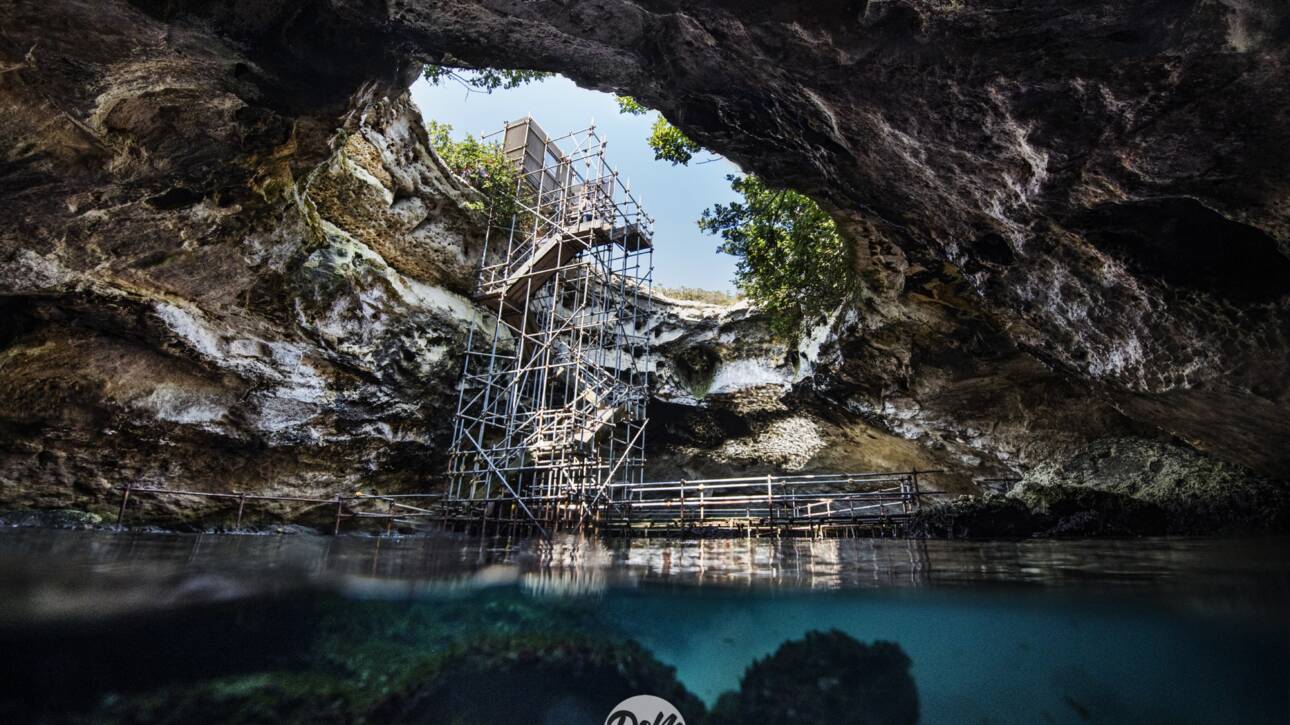
For centuries the Grotta della Poesia was simply part of the landscape: a pool of seawater inside the rock, known to fishermen and to the people of the Melendugno coast. Its name, from the medieval Greek posìa (“freshwater spring”), recalls that fresh water once rose here, a precious resource on a limestone coast.
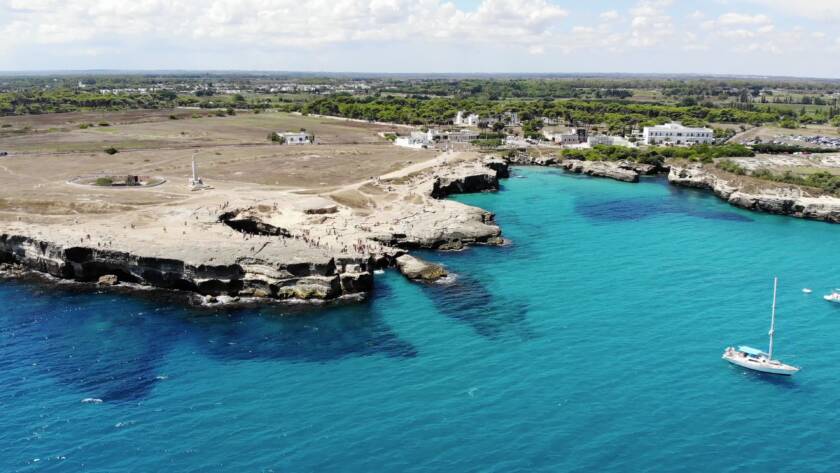
On the Roca headland two periods were clearly visible: the Messapian walls and the medieval citadel founded in the early 14th century and razed in 1544. Nobody imagined a much older settlement lay beneath, or that the walls of the smaller cave were covered in writing.
1983: Cosimo Pagliara’s discovery
In 1983 archaeologist Cosimo Pagliara, professor at the Institute of Archaeology of the University of Lecce (today the University of Salento), explored the Poesia Piccola, the inner cave, then reachable only from the sea through a submerged passage. All along its walls he found inscriptions in Messapic, Greek and Latin, and beneath them even older carvings.
Pagliara published his first notes in 1987 in the Annali della Scuola Normale Superiore di Pisa. To document such a fragile record his team made casts of the inscribed walls, covering some 600 square metres; some were exhibited in Acaya castle, and the University of Salento’s MUSA museum in Lecce displays reconstructions of Roca’s key finds.
What’s on the walls of the Poesia Piccola
The inscribed surfaces cover hundreds of square metres and span thousands of years:
- Figurative carvings, the oldest layer, from prehistory onwards: stylised animals, sailing boats, spirals, hands and feet, true “signatures” left by those who entered
- Hundreds of votive inscriptions, mostly in Messapic and to a lesser extent in Latin and Greek, dating mainly from the mid-4th to the late 2nd century BC
- The name of a god: the inscriptions invoke Taotor, with the epithet Andirahas; in Latin the name becomes Tutor
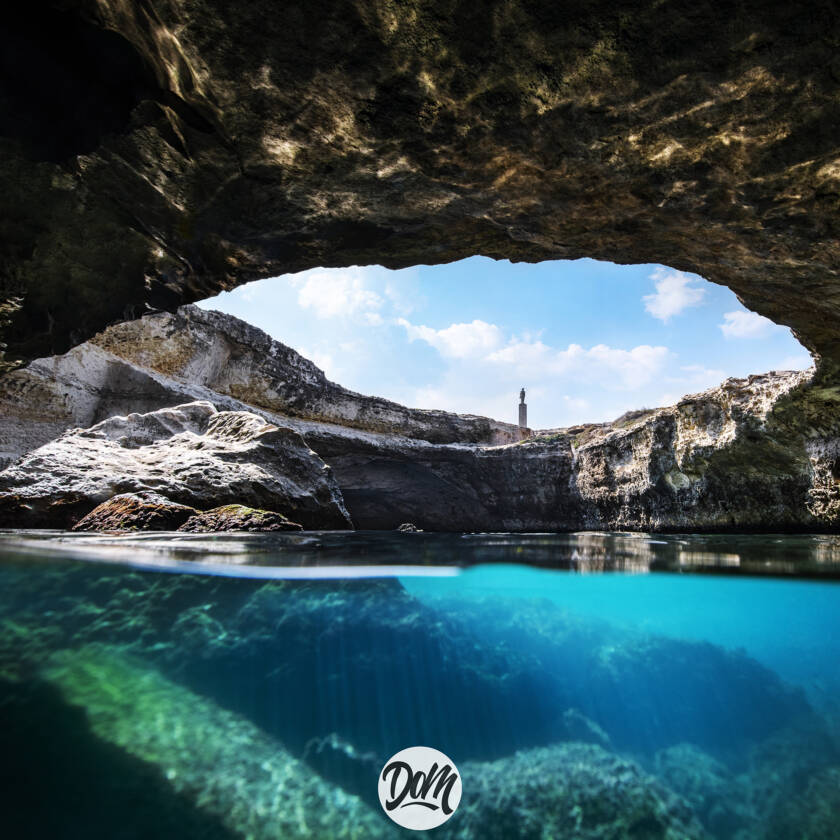
The people who carved them came from different walks of life: coastal villagers, merchants, sailors crossing the Strait of Otranto. The cave worked as a maritime sanctuary tied to fresh water and the sea. Read more in Taotor, the god of the Cave of Poetry.
From the cave to the Roca excavations
The 1983 discovery confirmed what Pagliara suspected: Roca had been an important place long before the Middle Ages. From the late 1980s a University of Salento team began systematic excavations on the headland, which continue today.
The results exceeded every expectation. Beneath the Messapian and medieval layers lay a fortified Bronze Age settlement, founded in the 17th century BC and completely forgotten. Roca is now considered one of the most important sites of Mediterranean prehistory: it has produced some of the best-preserved Bronze Age monumental architecture in southern Italy and the largest group of Mycenaean pottery ever found west of mainland Greece.
The Bronze Age walls
Between 1992 and 1996 excavations focused on the line of the fortifications. They revealed a massive circuit wall with a Monumental Gate and at least five posterns, narrow corridors through the wall. One chamber of the Monumental Gate measures about 12 × 4 metres, with walls still standing almost 4 metres high; originally they probably reached 8–10 metres.
The walls were destroyed and rebuilt several times between the Middle and the Final Bronze Age. The most dramatic destruction came between the 15th and 14th centuries BC: a siege followed by a great fire brought the structures down and burned almost the whole settlement. The collapse sealed the corridors, preserving objects just as they were shortly before the end.
Postern C, a scene frozen for 3,500 years
The most moving discovery came from Postern C, excavated in the mid-1990s. In the corridor archaeologists found groups of vessels carefully arranged and, at the inner end, the remains of seven people: two adults, a young person and four children. During the siege they had taken refuge in the passage, hiding behind a heap of pots, and died of asphyxia when the fire set to the walls filled the corridor.
Studied by Teodoro Scarano of the University of Salento, this context shows how a small group organised the space to survive, and remains one of the most direct records of a Bronze Age siege in the Mediterranean.
The hut-temple and the gold discs
After the destruction the settlement was rebuilt. In the Final Bronze Age, around the 11th century BC, the walls enclosed an orderly village of buildings and open spaces. The best-preserved structure is the so-called hut-temple, also destroyed by fire. Its remains included a “gold hoard” and a “bronze hoard” and, among the most celebrated finds, two pairs of golden sun discs.
In 2005 and 2006, near the inner face of the walls, excavators uncovered three large superimposed rectangular huts with plenty of Aegean pottery, local wares and animal bones: traces of sacrifices and ritual feasts. Roca was a harbour open to the Aegean world, a landing place in the bay of Torre dell’Orso.
Research today
- DigiRock (Regione Puglia, 2023–24): a laser scan of the entire cave by the CETMA research centre in Brindisi, a high-resolution digital twin of the walls and AI tools to recognise the signs
- Uncovering Messapic Texts: Inscriptions from Grotta Poesia (John Fell Fund, University of Oxford, 2024–25): working on the casts, researchers separated overlapping inscriptions, corrected earlier readings and identified recurring formulas, including previously unknown Messapic grammatical forms
- Conservation: the heritage authority in Lecce is working to remove the iron ladder that damages the cave and find an alternative access
Since 2026 the site has been run through a public-private partnership between the Municipality of Melendugno and ArtWork Società Cooperativa Sociale, for 15 years renewable, together with the University of Salento and the Soprintendenza. Visitors can book a guided visit or a virtual reality experience at archeoroca.it.
Timeline
- 17th c. BCA fortified Bronze Age settlement is founded on the headland
- 15th–14th c. BCA siege and fire destroy walls and village; seven people die in Postern C
- 11th c. BCFinal Bronze Age village with the hut-temple and the golden sun discs
- 4th–2nd c. BCMessapian period: a new wall of about 1,400 m; the Poesia Piccola is a sanctuary with dedications to Taotor
- Early 14th c.Walter VI of Brienne, Count of Lecce, refounds Roca as a fortified town
- 1480–1544Ottoman raids; in 1544 governor Ferrante Loffredo orders the town to be razed
- 1983Cosimo Pagliara discovers the inscriptions of the Poesia Piccola
- 1992–1996Excavation of the Bronze Age fortifications: Monumental Gate and posterns
- 2023–2025DigiRock and Oxford projects on the inscriptions
- 18 July 2026The archaeological area and caves open with a ticket
Keep exploring Roca
In-depth guides for travellers who want to understand the place, not just photograph it.
Roca Vecchia
Three thousand years on a headland: the Bronze Age fortress, the Messapians, the medieval town.
Taotor, the god of the cave
The Messapian deity invoked on the walls of the Poesia Piccola.
A heritage to protect
Why swimming is banned and how to visit without harming the site.